Eczema is not always red. Depending on your skin tone, affected skin can look red, white, purple or grey — or simply lighter or darker than the skin around it. That is not a fringe observation; it is how the NHS now describes atopic eczema, and dermatologist-reviewed American Academy of Dermatology education says the same for darker skin: dark brown, purple or grayish areas, often with small rough bumps.
If you have read description after description of "red, inflamed patches" and none of it matched your skin — or your child's — this article is for you. The gap is in the descriptions, not in your symptoms.
Key takeaways
- Eczema can look red, white, purple, grey, brown, or lighter or darker than surrounding skin, depending on skin tone.
- On darker skin, small rough bumps are more common, and patches may be dark brown, purple or grayish rather than red.
- After a patch heals, skin can stay lighter or darker where it was — a color change, not necessarily active eczema.
- Itch, dryness, texture and thickening carry information on every skin tone. Color is one clue, not the test.
- None of this is a diagnostic checklist. If your skin is changing, describe it to a clinician.
Where the "red" shorthand fails
"Red and inflamed" is a fair description of how eczema often looks on lighter skin — the AAD notes a red rash appears "especially on lighter skin tones." The problem is that shorthand quietly became the definition. Redness depends on seeing blood-flow changes through the skin's surface, and how visible that is varies with skin tone.
The better-written official sources now handle this directly. The NHS's own image descriptions for atopic eczema on dark brown skin mention patches that look "grey, white and dry," and areas both "darker and lighter than the skin around it" — no redness required.
What sources describe on darker skin
For atopic dermatitis — the most common form — the AAD's dermatologist-reviewed symptoms page is specific about darker skin tones:
- Areas of dark brown, purple, or grayish skin rather than red patches.
- Small, rough bumps, which are more common on darker skin; bumps tend to be gray to violet-brown in color.
- A different distribution in children: children with brown or black skin are more likely than white children to have atopic dermatitis on the trunk, and patches tend to form on the fronts of the knees, the elbows and the backs of the hands.
None of these makes eczema on darker skin a different disease. It is the same condition, described honestly across the range of skin it affects. For what distinguishes the types of eczema from one another, see Types of Eczema.
A note for parents: location also shifts with age, whatever the skin tone. The AAD describes babies developing atopic dermatitis on the cheeks, forehead or scalp; children roughly from age two to puberty in the creases of the elbows and knees and on the ankles, neck and wrists; and adults more often on the hands, feet and around the eyes. If you are watching a child's skin, knowing both the age pattern and the tone-specific colors above makes you a much better observer — and a better historian at appointments, since young children cannot describe an itch timeline themselves.
Color changes that can outlast the flare
The AAD notes that after healing, skin may be lighter or darker where atopic dermatitis was. This matters for two reasons.
First, expectations: a patch that has calmed down — no longer itchy, dry or raised — can still announce itself in color for a while. That residual change is not automatically active eczema, and it is not evidence that treatment failed.
Second, description: when you tell a clinician "this area is darker than the rest," it helps to say whether the area is also itchy, rough or thickened right now, or whether the color is what remains after a flare settled. Those are different situations, and you are the only witness to the sequence.
Beyond color: signals that work on every skin tone
Color is the least reliable part of the standard description, so lean on the parts that are tone-neutral. Across the NHS and AAD symptom lists:
- Itch — the near-constant of eczema, on every skin tone.
- Dryness, cracking, crusting and scaling — texture you can feel as well as see.
- Thickening — skin that becomes leathery or raised over time in a repeatedly affected area.
- Behavior over time — flares and calmer periods, and patterns around exposures, covered in Eczema Flare-Ups: Common Triggers.
If the texture and itch story fits eczema, do not let an absent color talk you out of getting the skin looked at.
Type by type: what the sources describe
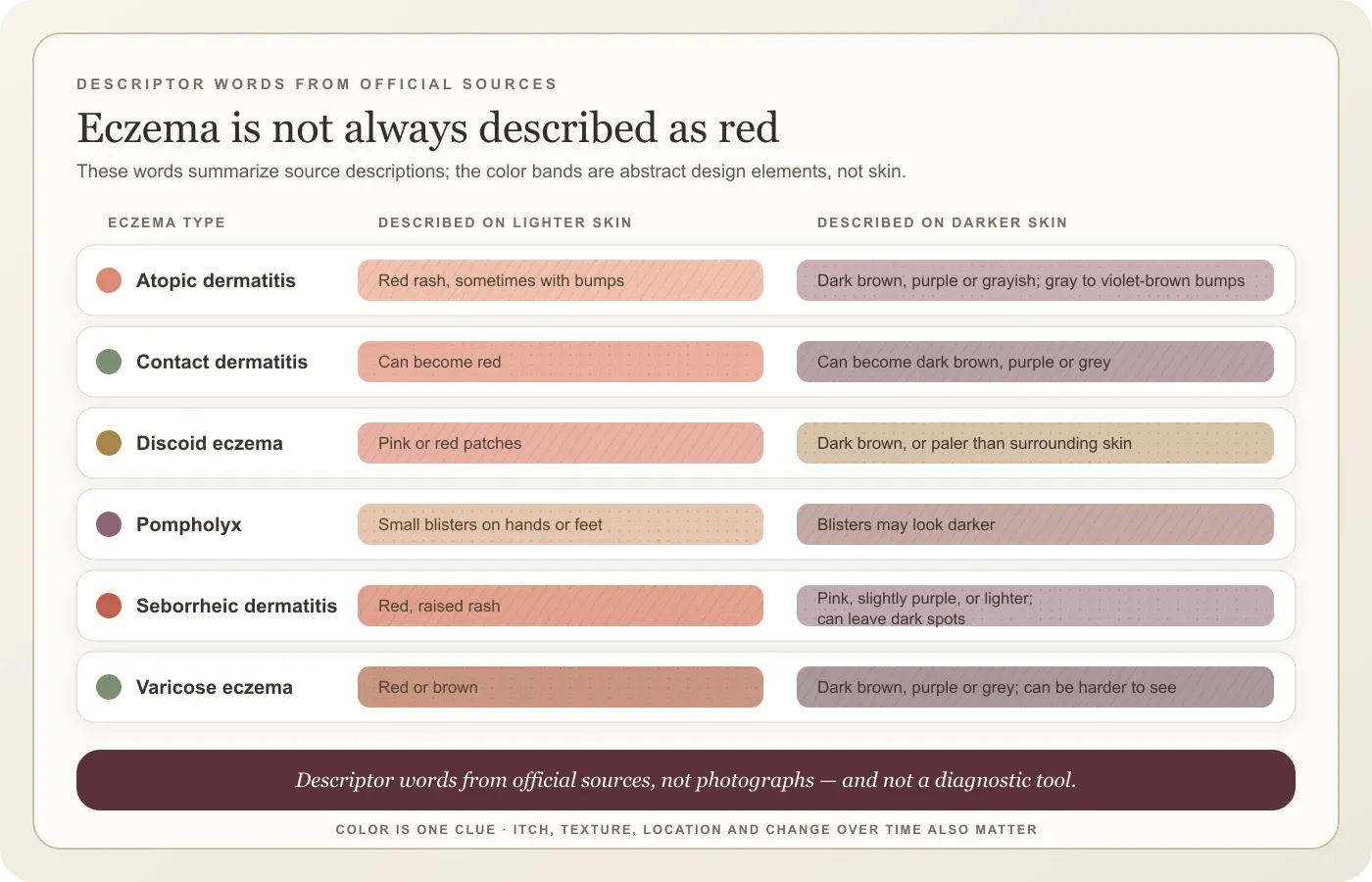
Each row below comes from that condition's own NHS or AAD page — this is how official descriptions read once skin tone is taken seriously.
| Type | Described on lighter skin | Described on darker skin | What to note |
|---|---|---|---|
| Atopic dermatitis | Red rash, sometimes with bumps | Dark brown, purple or grayish areas; gray to violet-brown bumps | Bumps more common on darker skin |
| Contact dermatitis | Can become red | Can become dark brown, purple or grey | Appears where the substance touched |
| Discoid eczema | Pink or red patches | Dark brown, or paler than surrounding skin | Distinct round or oval shape |
| Pompholyx | Small blisters on hands or feet | Blisters may look darker | Intense itch often comes first |
| Seborrheic dermatitis | Red, raised rash | Pink, slightly purple, or lighter; can leave dark spots | Follows oily areas like scalp and face |
| Varicose eczema | Red or brown | Dark brown, purple or grey; can be harder to see | Lower legs; deserves assessment |
The varicose row carries its own caution, straight from the NHS: on darker skin this rash "can sometimes be more difficult to see." Subtle lower-leg changes are still worth showing to a clinician.
Describing your skin so it helps
You do not need clinical vocabulary. A description built from the tone-neutral signals works on any skin:
"The patch on my forearm is darker than the skin around it, feels rough and dry, itches most at night, and has been there about three weeks. A similar one healed last year and left a lighter mark."
That single sentence gives location, color relative to your own skin, texture, itch pattern, duration and history. Preparing for a Dermatology Appointment builds this into a fuller routine, including a simple symptom log.
When to seek help
The urgent signs do not depend on skin tone. Seek prompt medical assessment if skin becomes blistered or crusty, leaks fluid or develops pus-filled spots; if it is painful, swollen or feels warm; if symptoms suddenly get worse; or if a high fever accompanies a skin change.
And for everything short of urgent: if your skin is changing and the descriptions you have read never quite fit, that is a reason to be seen — not a reason to wait until it looks like the pictures.
Sources
- American Academy of Dermatology — Atopic dermatitis: Signs and symptoms (last updated October 10, 2023)
- NHS — Atopic eczema (last reviewed September 6, 2024)
- NHS — Contact dermatitis (last reviewed May 3, 2023)
- NHS — Discoid eczema (last reviewed March 23, 2023)
- NHS — Pompholyx (dyshidrotic eczema) (last reviewed July 30, 2026)
- American Academy of Dermatology — Seborrheic dermatitis: Overview (last updated December 6, 2022)
- NHS — Varicose eczema (last reviewed April 20, 2023)
Source note: AAD states that its eczema content was developed by the organization and acknowledges support from Sanofi and Regeneron.
This article provides general educational information and is not a substitute for diagnosis or individualized advice from a qualified healthcare professional.